
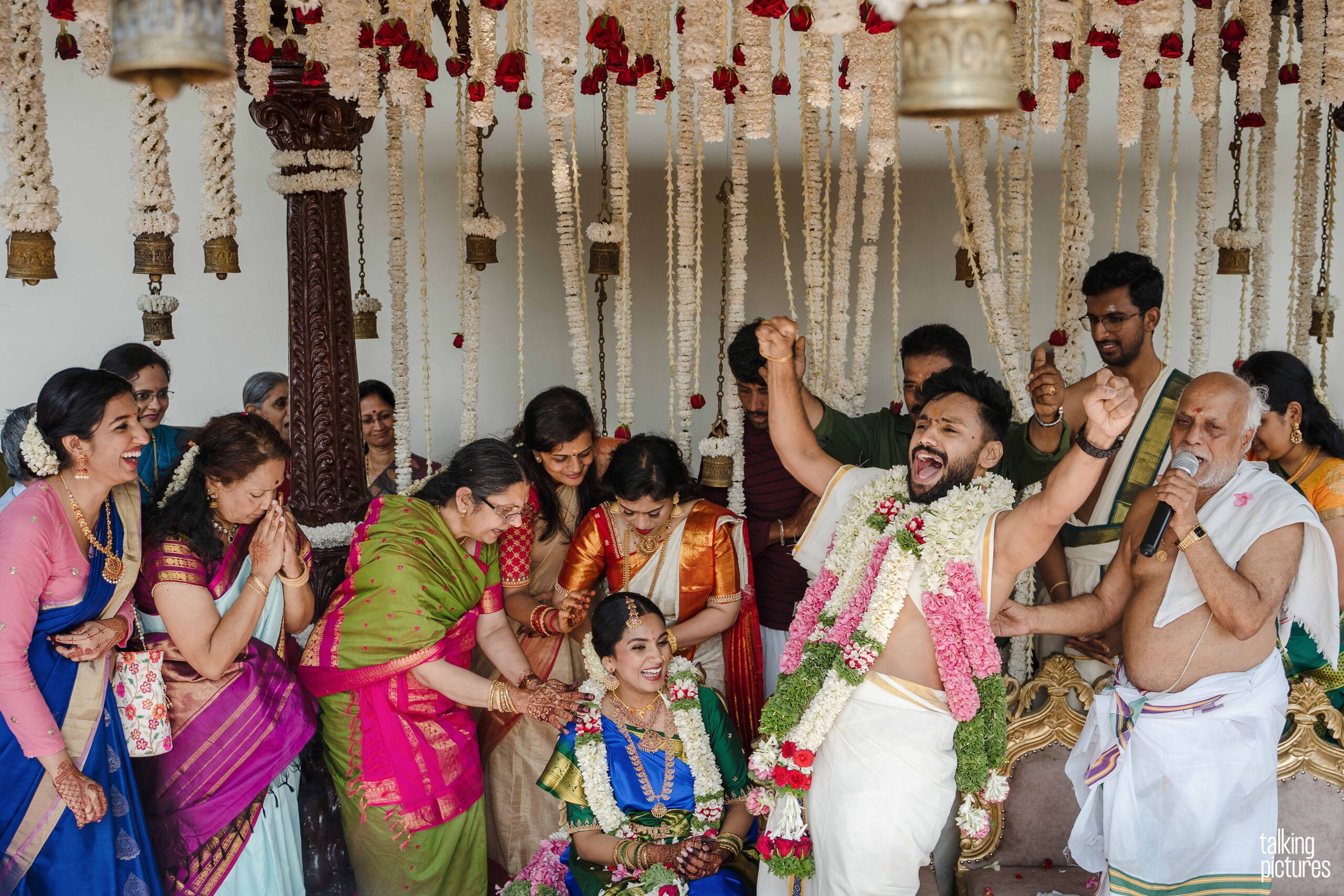
The first thing that surprises people about a Kerala wedding is how fast it is.
Guests who have been to North Indian weddings arrive expecting three days of functions and a ceremony that runs late into the night. Instead they find a morning event, a ceremony of perhaps thirty or forty minutes, and the single most important ritual of the entire marriage finished in about four seconds.
We have been photographing weddings across Kerala for years, and that compression is the defining fact of the job. There is no second take. If you are adjusting a lens when the thali is tied, you have missed it, and no amount of skill afterwards recovers it.
This is the full sequence, in order, with honest notes on how long things take and what tends to go wrong.
One thing to say first: Kerala is not one tradition. A Nair wedding, an Ezhava wedding and a Namboothiri wedding differ from each other in meaningful ways, and Syrian Christian and Mappila Muslim ceremonies are separate traditions entirely. What follows is the broad Hindu sequence you will encounter most often. Your family’s version will have its own variations — and those variations are the interesting part, not a departure from some correct version.
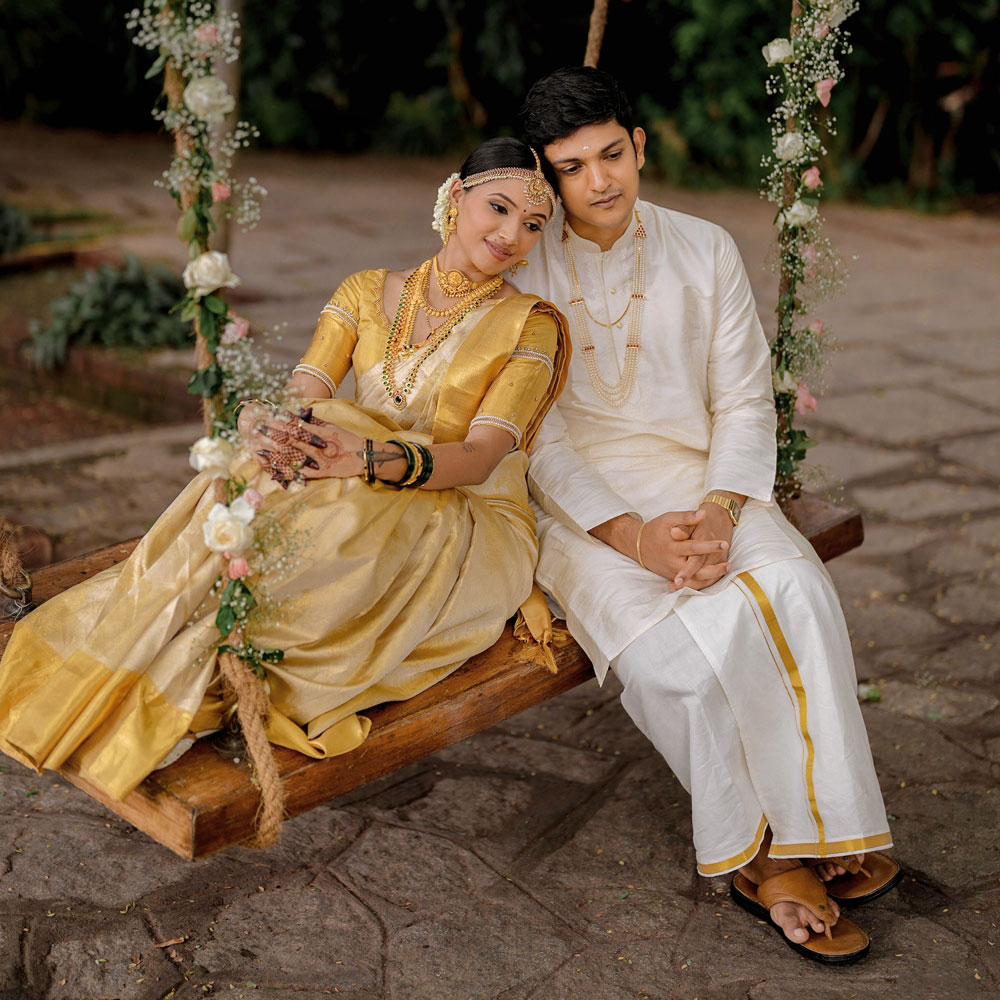
Before the wedding day
Horoscope matching and fixing the muhurtham
Nothing begins until an astrologer compares both horoscopes and identifies auspicious dates. In Kerala Hindu tradition no wedding date is set without this consultation, and the muhurtham — the exact auspicious window — then governs everything else.
This has a very practical consequence that catches families out every single year. Because the whole community works from the same calendar, weddings cluster onto a handful of dates. On those days every decent priest, nadaswaram group, sadya caterer and photographer in the district is booked at the same time.
If you take three weeks to decide after your date is fixed, you will find your first three choices unavailable. Book within days.
Nischayam
The formal engagement. Both families gather, usually at the bride’s home or a hall, with a priest and the elders present. Rings are exchanged, gifts and jewellery are given, and the marriage is formally declared.
If you have only seen North Indian engagements, Nischayam will feel almost understated. It is a declaration rather than a party — dignified, relatively brief, more about the two families formally committing than about celebration.
What’s worth capturing: the written agreement passing between the families, and the elders’ blessings afterwards. In our experience these are the Nischayam photographs families actually come back to.
Nalunniyattu
Kerala’s turmeric ceremony, performed at the bride’s and groom’s own homes, usually a day or two before the wedding. Oil and turmeric are applied by the women of the family.
It is worth understanding how different this is from its North Indian equivalent. A Marwari haldi ceremony is loud, messy and deliberately chaotic — cousins flinging turmeric, music, someone ending up in the water. Nalunniyattu is closer to a blessing. Quieter, gentler, performed with care rather than enthusiasm.
Same ingredient, almost opposite mood, and photographed completely differently.
The wedding day
Most Kerala Hindu weddings happen in the morning, because that is where the auspicious windows usually fall. Plan around an early start — hair and makeup often begin before sunrise.
The groom’s arrival
The groom’s party arrives and is received at the entrance by the bride’s family, to nadaswaram and chenda. Many families include thalappoli — young girls carrying lamps and flowers — and a formal welcome with a lit nilavilakku.
What’s worth capturing: this is one of the few genuinely cinematic sequences of a Kerala wedding, and it happens outdoors in good morning light. It is also the moment most commonly missed, because photographers are still setting up inside the hall. Any team that has worked weddings in and around Thrissur will be outside and ready before the cars arrive.
At the mandapam
The couple are seated at the mandapam, usually before a lit nilavilakku. Depending on the family there may be a Ganapathi pooja to open proceedings.
From this point the ceremony moves quickly, and it does not pause for anyone.
Kanyadaanam
The bride’s father formally gives his daughter to the groom, placing her hand into his. In Kerala weddings this is performed with real weight, and for many families it is the emotional centre of the entire day.
What’s worth capturing: do not watch the couple here. Watch the father. Watch the mother standing at the edge of the mandapam. The strongest frame of the wedding is very often on a face nobody else is looking at.
Thalikettu
The defining ritual. The groom ties the thali — a small gold pendant on a thread, traditionally cotton dyed with turmeric — around the bride’s neck. In many families the bride’s sister or a close relative helps fasten it behind her neck.
This is the moment the marriage is made. It takes about four seconds.
What’s worth capturing: everything about this ritual punishes hesitation. No rehearsal, no repeat, no announcement beyond the priest’s chanting shifting. Position, focus and exposure all have to be settled before it starts. We have watched photographers at other weddings miss it entirely because they were changing a lens.
If you are hiring, ask any photographer directly how they handle the Thalikettu. The answer separates people who have shot Kerala weddings from people who have shot weddings.
Pudavakoda
Immediately afterwards — and we mean immediately — the groom presents the bride with a saree, the manthrakodi. She accepts it, and in many families then changes into it.
Because it follows the Thalikettu with no real gap, this is the second most commonly missed ritual. The two should be treated as one continuous moment rather than two separate ones.
Garland exchange and pradakshinam
The couple exchange garlands, then circle the nilavilakku or the sacred fire together, usually three times.
What’s worth capturing: this is the one part of the ceremony with predictable, repeating movement. Three circuits means three attempts at the same frame from three different positions. A good team uses that rather than shooting the same angle three times.
Aashirvadam
The couple seek blessings from elders on both sides, who sprinkle rice over them.
Unhurried and warm, full of small unrepeatable moments, and for many families these end up being the photographs that get printed and framed rather than the ceremony shots.
Sadya
The wedding closes with the sadya — a vegetarian feast served on a banana leaf, each dish placed in its own position in a set order.
It is not an afterthought. For a good number of guests it is the main event, and there is real skill in the serving, done at speed down long rows of seated people.
A few things worth knowing if it is your first:
- The leaf is placed with the narrow end to your left
- Eat with your right hand
- Dishes arrive in sequence — do not start until the rice and the first curries are served
- When you have finished, fold the leaf towards yourself. Folding it away is traditionally read as dissatisfaction with the meal
That last one matters more than you would think, and almost nobody tells first-time guests.
After the wedding
Grihapravesham
The bride is formally received into the groom’s home, welcomed at the threshold with a lamp and traditional rituals. Some families do this the same day, others the following one.
It is the quietest part of the whole sequence and frequently the most tender, because by then everyone has stopped performing for the room.
Temple weddings
Many Kerala couples marry at a temple rather than a hall — Guruvayoor being the most sought-after, with thousands of weddings a year.
Temple weddings follow broadly the same ritual sequence, but with important practical differences: ceremonies run in allotted slots, dress codes are enforced for everyone including vendors, and photography permissions vary by area within the complex.
If you are considering a temple wedding, confirm all three of those in writing with the temple office well in advance. Do not rely on what a relative remembers from a wedding five years ago.
Frequently asked questions
How long does a Kerala wedding ceremony take?
The core ceremony is typically thirty to sixty minutes. Including the groom’s arrival, the blessings and the sadya, the whole morning usually runs three to four hours. This is substantially shorter than most North Indian weddings, and guests should plan accordingly.
What time do Kerala weddings start?
Usually early morning, because auspicious muhurtham timings tend to fall then. Ceremonies beginning between 7am and 11am are common. Confirm the exact muhurtham with the family rather than assuming.
What should I wear as a guest?
Traditional attire is expected, though the standard is elegant rather than extravagant. Women commonly wear sarees — the kasavu, off-white with a gold border, being the classic Kerala choice. Men wear a mundu with a shirt, or formal Indian wear. For a temple wedding, check the specific dress code in advance, as it is enforced at the entrance.
What is the difference between the thali and the minnu?
Both are the pendant tied around the bride’s neck to mark the marriage. The terminology varies by community — the Hindu thali and the Syrian Christian minnu serve the same symbolic purpose within their own traditions, with different designs and different ritual contexts.
When should guests arrive?
Earlier than you think. The ceremony is short and the Thalikettu happens partway through, so arriving even twenty minutes late can mean missing the central moment entirely. If the invitation says the muhurtham is at 9:15, be seated by 8:45.
Do I need to bring a gift?
Cash in an envelope is standard and always appropriate. Hand it to the family rather than leaving it on a table.
If you are planning your own wedding
Three things follow from all of the above, and they are the three we would tell any couple.
Tell your guests when to actually arrive. Not the function time — the time to be seated. People who turn up on Indian Standard Time will miss the Thalikettu, and they will mind more than you expect.
Give your photographer your family’s ritual sequence in advance. Not the venue and timings — the actual order of rituals as your family performs them, including any variation specific to your community. A team that knows the sequence beforehand is standing in the right place before the moment happens, rather than reacting after it.
Leave room around the ceremony. The muhurtham fixes the ceremony, but everything else — the arrival, the portraits, the sadya — gets compressed when families try to fit too much into one morning. The rituals themselves are short. The day does not need to be rushed.
If you would like to see our recent work from Kerala weddings, or you are thinking about a wedding film alongside photographs, we would be glad to talk it through. Get in touch and tell us about your date.
No Comments